
We may earn money or products from the companies mentioned in this post.
If you are comparing APEC ROES-50 vs iSpring RCC7AK, the biggest difference is not whether both can provide reverse osmosis drinking water—they can. The real choice is between APEC’s simpler 5-stage, 50 GPD system and iSpring’s higher-capacity 75 GPD system with an added alkaline remineralization stage.
Quick answer: Choose the APEC ROES-50 if you want a straightforward traditional RO system with a 4-gallon storage tank, industry-standard components, and WQA Gold Seal certification. Choose the iSpring RCC7AK if you want higher rated output and prefer minerals added back to the water after reverse osmosis.
APEC ROES-50 vs iSpring RCC7AK: Quick Comparison
| Feature | APEC ROES-50 | iSpring RCC7AK |
|---|---|---|
| Filtration stages | 5 | 6 |
| Rated capacity | 50 GPD at 60 psi | 75 GPD |
| Remineralization | No | Yes |
| System style | Traditional tank RO | Traditional tank RO |
| Certification | WQA Gold Seal certified | NSF/ANSI 58 certified |
| Electricity required | No | No |
| Best for | Simplicity and traditional RO | Higher output and remineralization |
Our pick for most buyers: The iSpring RCC7AK has the more versatile feature set because its 75 GPD rating and alkaline remineralization stage address two common concerns with traditional RO: recovery capacity and the flat taste some people associate with highly purified water. However, buyers who prefer fewer stages and a simpler system may reasonably choose the APEC instead.
Filtration Stages and Water Taste
Both systems use reverse osmosis as the core treatment method, but they handle the water differently after the RO membrane.
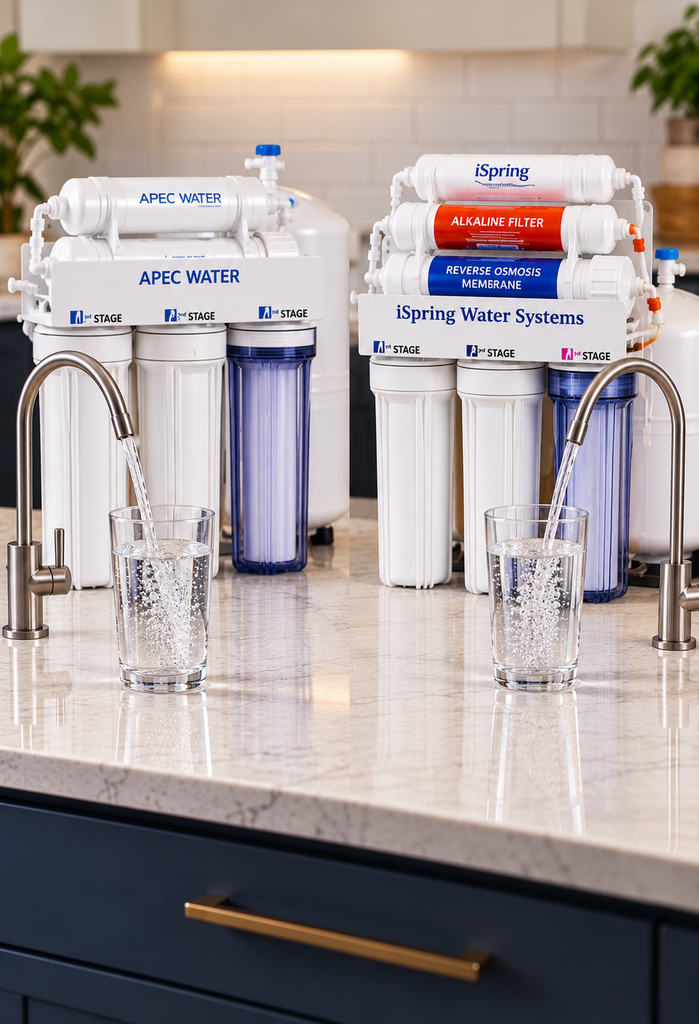
The APEC ROES-50 uses five stages. Water first passes through sediment filtration and two carbon stages before reaching the reverse osmosis membrane. A final coconut-shell carbon filter polishes the water after it leaves the storage tank.
The iSpring RCC7AK adds a sixth alkaline remineralization stage. Reverse osmosis removes dissolved substances from water, including minerals. The additional iSpring stage is designed to add selected minerals back after RO treatment and alter the finished water’s mineral balance and taste.
This does not make remineralized water universally “better.” Some people prefer the clean, neutral character of standard RO water, while others prefer water with some mineral content restored. The RCC7AK simply gives buyers that feature without requiring a separate remineralization add-on.
Output and Household Capacity
The iSpring has the advantage on rated production capacity. The RCC7AK is rated at 75 gallons per day, while APEC rates the ROES-50 at 50 gallons per day at 60 psi. APEC also notes that output can be about 30 GPD at 50 psi and 77°F.
Those ratings do not mean a household needs dozens of gallons of drinking water every day. With a traditional tank-style system, higher membrane capacity can matter because it affects how quickly the system can replenish filtered water after the storage tank is drawn down.
For a small household with normal drinking and cooking use, 50 GPD may be entirely adequate. Larger households or people who frequently use RO water for cooking, coffee, ice, and large bottles may appreciate the additional rated capacity of the iSpring.
If high-flow delivery is your main priority, a tankless system is another category worth considering. Our Waterdrop G3 P800 review covers a much higher-output tankless alternative.
Certification and Performance Confidence
Certification is one of the most important areas to examine when comparing water filters because marketing claims and independently verified performance are not the same thing.
APEC lists the ROES-50 as a WQA Gold Seal Certified System. The manufacturer specifically describes testing related to TDS reduction along with system materials and construction.
The iSpring RCC7AK is listed under NSF/ANSI 58, the standard associated with reverse osmosis drinking water treatment systems. NSF’s official product listings include the RCC7AK.
Neither certification label should be treated as permission to assume every contaminant mentioned in advertising is certified for every reduction claim. If you are buying specifically for lead, fluoride, arsenic, PFAS, nitrate, or another contaminant, compare your water test or local water-quality report with the applicable certified performance data before purchasing.
Installation and Under-Sink Space
These are both traditional under-sink RO systems, which means they require more cabinet space than a narrow tankless unit. You need room for the filtration assembly, storage tank, tubing, drain connection, and dedicated drinking-water faucet.
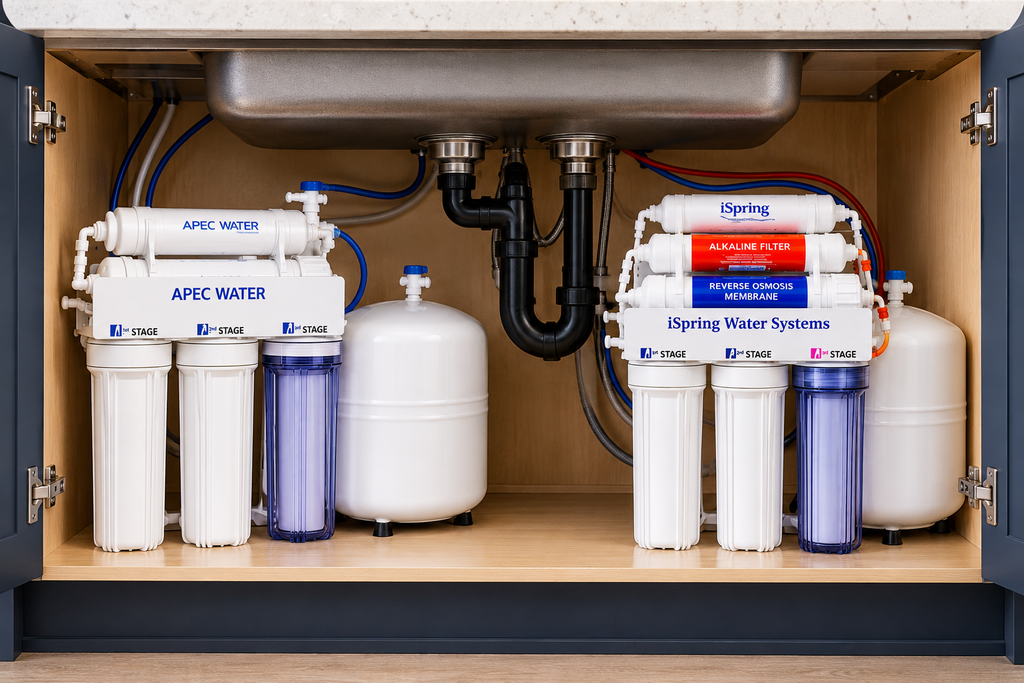
The APEC filtration assembly measures approximately 15.5 × 5.25 × 17 inches, and its 4-gallon tank measures roughly 11 × 11 × 15 inches. The iSpring filtration assembly is approximately 15.5 × 5.1 × 19 inches, with its storage tank occupying additional cabinet space.
Neither standard system requires electricity, which is an advantage over many high-output tankless RO systems. Both manufacturers position their systems for DIY installation, but the actual difficulty depends on your sink, countertop, plumbing layout, and comfort working with water connections.
Before ordering either one, measure the usable cabinet space rather than just the cabinet’s outside dimensions. Garbage disposals, plumbing traps, cleaning supplies, and pull-out organizers can reduce the space available for an RO tank and filter assembly.
Filter Replacements and Long-Term Ownership
One advantage shared by these systems is that they use a more traditional modular design rather than a sealed all-in-one appliance. That can make maintenance more familiar for homeowners who are comfortable changing standard-style filter cartridges.
APEC emphasizes the ROES-50’s industry-standard-sized parts and filters. iSpring likewise uses standard-sized replacement filters and promotes broad replacement-filter availability.
The iSpring has one additional consumable component because of its remineralization stage. That is the tradeoff for getting mineral restoration built into the system. Replacement intervals also depend on incoming water quality and household usage, so ongoing costs should be evaluated using current filter prices rather than a single fixed annual estimate.
For more context on this style of system, see our guide to under-sink water filtration systems.
APEC ROES-50 Pros and Cons
Pros
- Simple 5-stage reverse osmosis design
- WQA Gold Seal certified system
- Industry-standard-sized filters and components
- 4-gallon storage tank included
- No electricity required
- Broad 40–85 psi specified feed-pressure range
- Good fit for buyers who do not want remineralization
Cons
- Lower 50 GPD rating than the iSpring
- No built-in remineralization stage
- Storage tank takes significant cabinet space
- Traditional RO output is slower than high-output tankless systems
iSpring RCC7AK Pros and Cons
Pros
- Higher 75 GPD rated capacity
- Sixth-stage alkaline remineralization included
- NSF/ANSI 58 certified
- No electricity required
- Standard-sized replacement filters
- Good fit for households that prefer remineralized RO water
Cons
- Extra remineralization stage adds another replacement component
- Storage tank and filter assembly require cabinet space
- Feed-pressure range is narrower than APEC’s published range
- Buyers who prefer plain RO water may not value the alkaline stage
Which One Should You Buy?
Choose the APEC ROES-50 if: you want a proven, straightforward 5-stage RO system, do not care about remineralization, and value a traditional design with industry-standard components and a broad specified operating-pressure range.
Choose the iSpring RCC7AK if: you want the higher 75 GPD rating, specifically want alkaline remineralization built in, or prefer the reassurance of the RCC7AK’s NSF/ANSI 58 listing.
If neither sounds ideal, our best water filters for home guide compares these traditional RO approaches with tankless RO and no-installation filtration options.
Final Verdict: APEC ROES-50 vs iSpring RCC7AK
For most buyers deciding strictly between these two systems, we give the iSpring RCC7AK a slight edge. Its 75 GPD rated output and built-in remineralization provide more capability without requiring electricity.
That does not make the APEC ROES-50 a lesser system. Its simpler 5-stage configuration is arguably the better choice for someone who wants conventional RO water, fewer filtration stages to maintain, and no interest in altering the water after the RO membrane.
The right winner therefore depends on one question: Do you want remineralization and higher rated output? If yes, choose iSpring. If not, the APEC’s simpler approach remains highly competitive.
Frequently Asked Questions
Does the iSpring RCC7AK produce more water than the APEC ROES-50?
On their published ratings, yes. iSpring rates the RCC7AK at 75 GPD, while APEC rates the ROES-50 at 50 GPD at 60 psi. Real-world production varies with pressure, temperature, water chemistry, and filter condition.
Which system adds minerals back to RO water?
The iSpring RCC7AK includes a sixth-stage alkaline remineralization filter. The standard APEC ROES-50 is a five-stage system without a remineralization stage.
Do either of these reverse osmosis systems require electricity?
No. The standard APEC ROES-50 and iSpring RCC7AK operate without an electrical power connection.
Which system takes up less space?
Both use traditional filter assemblies plus storage tanks, so both require meaningful under-sink space. Their filter assemblies are similar in width and depth, although the iSpring assembly is somewhat taller based on current published dimensions. Your plumbing and tank placement may matter more than the small difference between the filter assemblies.