
We may earn money or products from the companies mentioned in this post.
If you are considering a premium tankless reverse osmosis system, the Waterdrop G3 P800 review question comes down to three things: how much filtered water your household uses, how much under-sink space you want to save, and whether the system’s higher upfront cost is justified by its speed and efficiency.
The G3P800 stands out with an 800 GPD rated capacity, a 3:1 pure-to-drain ratio, tankless construction, and a smart faucet that displays water-quality and filter-life information. Those features make it especially appealing for busy households that want RO water without waiting on a small storage tank to refill.
Waterdrop G3 P800 Review: Quick Verdict
Our verdict: The Waterdrop G3P800 is a strong choice for homeowners who want a high-output, space-saving reverse osmosis system with smart monitoring and relatively efficient wastewater performance. Its biggest tradeoffs are the premium price, ongoing proprietary filter replacements, the need for electricity, and the fact that the standard configuration does not add minerals back to the water.
- Best for: Households that want fast tankless RO output and smart monitoring
- Rated capacity: 800 gallons per day
- Pure-to-drain ratio: 3:1
- Design: Tankless under-sink RO
- Key drawback: Premium cost and electricity requirement
Waterdrop G3P800 Key Specifications
| Model | Waterdrop G3P800 |
| System type | Tankless under-sink reverse osmosis |
| Rated capacity | 800 GPD |
| Pure-to-drain ratio | 3:1 |
| Filtration | 10-stage filtration |
| Faucet | Smart faucet |
| Dimensions | 18.11 × 5.67 × 17.73 inches |
| Weight | 32.4 lb |
| Electricity required | Yes |
| Manufacturer-listed certifications | NSF/ANSI 42, 53, 58 and 372 |
| Warranty | 1 year |
What Is the Waterdrop G3P800?
The Waterdrop G3P800 is a high-capacity reverse osmosis system designed to fit beneath a kitchen sink without a traditional pressurized storage tank. Instead of slowly filling a tank and dispensing stored water, the system filters water on demand.
That design solves two common complaints about traditional RO systems: bulky tanks taking up cabinet space and slower recovery after heavy water use. Waterdrop rates the G3P800 at 800 GPD, putting it well above the output of many conventional residential RO systems.
That does not mean a typical household will use anywhere close to 800 gallons of drinking water each day. The higher rating is more useful as an indication of the system’s ability to deliver filtered water quickly when you fill glasses, pots, bottles, or coffee makers.
Filtration and Certifications
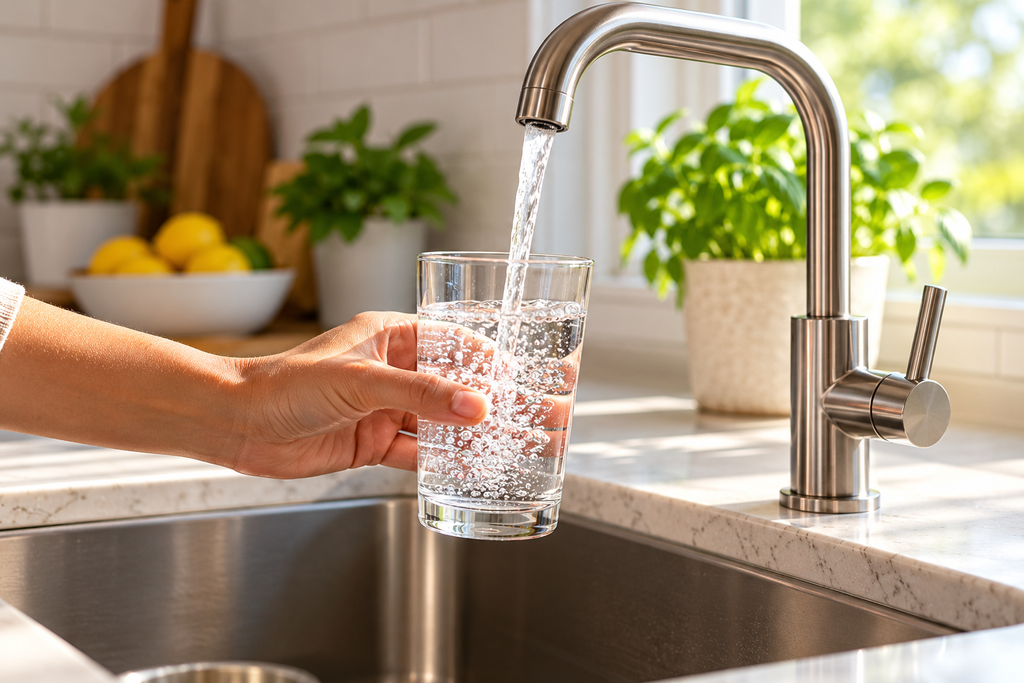
Waterdrop describes the G3P800 as a 10-stage filtration system built around reverse osmosis technology. The RO membrane is the central component, while the additional filtration stages help address sediment, chlorine-related taste and odor, and other substances covered by the system’s filtration design.
Certification deserves closer attention than a long list of contaminant claims. Waterdrop currently lists the G3P800 under NSF/ANSI 42, 53, 58 and 372 standards. Certification should always be interpreted according to the specific performance claims and scope listed for the product rather than as a blanket guarantee that every possible contaminant is removed.
If a particular contaminant is the reason you are buying a filter, check your local water-quality report or test your water first, then confirm that the system’s certified performance data addresses that specific concern.
Flow Rate and Water Efficiency
The G3P800’s 800 GPD rating is one of its biggest selling points. High output matters most when several people use filtered water throughout the day or when you regularly fill larger containers and cookware.
Waterdrop also specifies a 3:1 pure-to-drain ratio. In practical terms, the manufacturer says the system can produce about three cups of filtered water for every one cup sent to the drain under its rated conditions. Reverse osmosis inherently produces some reject water, so efficiency is an important factor when comparing systems.
Actual performance can vary with feed-water pressure, temperature, water chemistry, filter condition, and household plumbing. Treat rated capacity and efficiency as standardized product specifications rather than a promise that every installation will produce identical results.
Smart Faucet and Everyday Usability
The included smart faucet is one of the clearest differences between the G3P800 and a basic RO system. It provides at-a-glance information such as TDS readings and filter-life status, reducing the need to guess when maintenance is approaching.
TDS is useful as a general indicator of dissolved solids, but it should not be treated as a complete water-safety test. A low TDS reading does not tell you everything that may or may not be present in water. The more practical benefit of the display is convenient system monitoring.
Installation and Space Requirements
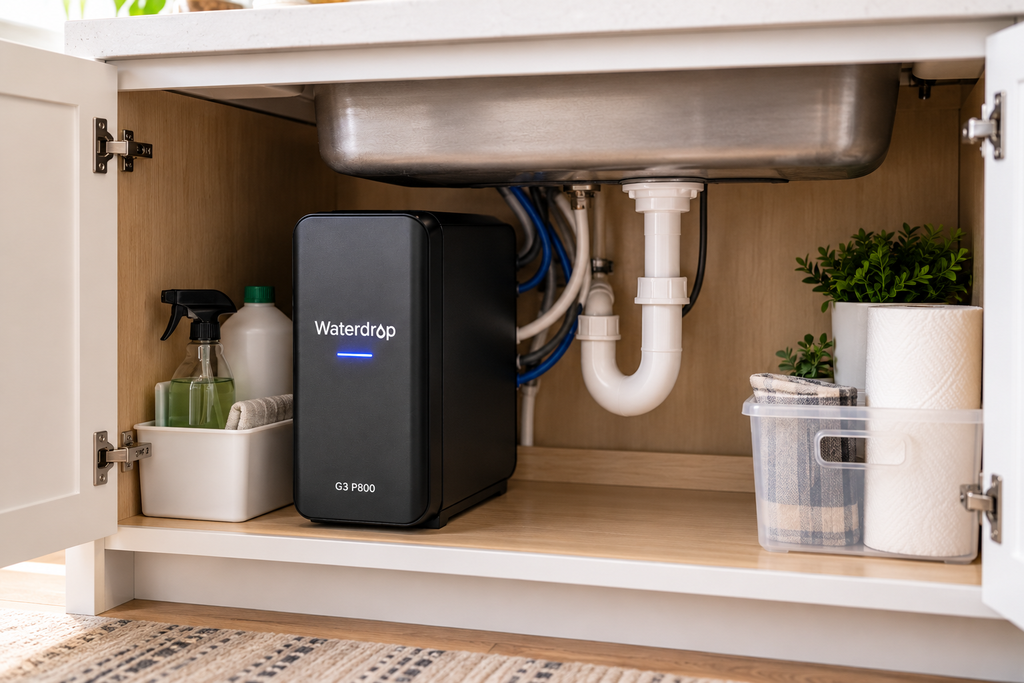
The tankless design can free up meaningful cabinet space compared with a traditional RO system that uses a separate storage tank. The main unit measures approximately 18.11 inches deep, 5.67 inches wide, and 17.73 inches high, so measure the cabinet before ordering.
The system also requires an electrical connection. That can be an overlooked issue if your sink cabinet does not already have a suitable outlet. Installation involves connecting to the cold-water supply, installing the drain connection, routing tubing, and installing the dedicated faucet.
Waterdrop provides DIY installation instructions, but whether you should install it yourself depends on your comfort level with plumbing and your sink configuration. If drilling a faucet opening, modifying plumbing, or adding power is required, professional installation may be the easier option.
If you are still comparing configurations, our guide to under-sink water filtration systems explains the broader category and the tradeoffs involved.
Filter Replacement and Ongoing Ownership
The purchase price is only part of the cost of owning a reverse osmosis system. Replacement filters matter because the G3P800 uses multiple filter cartridges on different schedules.
- CF filter: approximately every 6 months
- CB filter: approximately every 12 months
- G3P800 RO membrane: approximately every 24 months
These are Waterdrop’s current replacement guidelines, not guaranteed lifespans. Actual replacement frequency can vary based on water quality and usage. The smart faucet’s filter-life monitoring helps make this maintenance easier to track.
Waterdrop’s current comparison information estimates average annual replacement-filter costs at roughly $160 for the G3P800, but filter pricing can change. Check current replacement-filter prices before buying so you understand the long-term cost rather than focusing only on the system’s purchase price.
Waterdrop G3P800 Pros and Cons
Pros
- High 800 GPD rated capacity
- Tankless design saves under-sink space
- 3:1 pure-to-drain ratio
- Smart faucet displays TDS and filter-life information
- Manufacturer lists NSF/ANSI 42, 53, 58 and 372 certifications for applicable claims
- No storage tank to wait on after heavy use
- Longer RO membrane replacement interval than the prefilters
Cons
- Premium purchase price compared with many traditional RO systems
- Requires electricity
- Replacement filters create an ongoing ownership cost
- Standard configuration does not include alkaline remineralization
- Installation is more involved than using a countertop filter or pitcher
- One-year manufacturer warranty is relatively modest for a premium appliance
Who Should Buy the Waterdrop G3P800?
The G3P800 makes the most sense for a household that already wants reverse osmosis and is willing to pay more for speed, cabinet-space savings, and smart monitoring.
It is particularly compelling if you frequently fill large water bottles, cook with filtered water, have several household members using the system, or dislike the limited recovery capacity of smaller tank-based RO units.
It is also a better fit when under-sink space is valuable. Removing the bulky storage tank leaves more room for cleaning supplies, trash systems, or other cabinet storage.
Who Should Skip It?
You may be better served by another system if your top priority is keeping upfront and replacement costs low. A simpler traditional RO system can provide excellent drinking water without paying for 800 GPD capacity or smart features you may not need.
The G3P800 also may not be ideal if you do not have convenient electrical access beneath the sink or if you specifically want minerals added back to the water. Waterdrop sells remineralization options, but the standard G3P800 itself is not an alkaline-mineralization system.
Renters or anyone who wants zero plumbing changes may prefer a pitcher or countertop system instead.
Waterdrop G3P800 vs. Traditional Tank Reverse Osmosis
The decision between the G3P800 and a traditional tank RO system is less about which technology is universally better and more about which compromises you prefer.
| Feature | Waterdrop G3P800 | Traditional Tank RO |
|---|---|---|
| Water delivery | High-output on demand | Draws from storage tank |
| Cabinet space | Tankless, narrow unit | Separate tank takes additional space |
| Electricity | Required | Many basic systems do not require it |
| Monitoring | Smart faucet | Usually basic faucet |
| Complexity | More electronics/components | Simpler design |
| Typical appeal | Speed, efficiency, technology | Simplicity and value |
For a broader comparison of the G3P800 with other filtration approaches, see our guide to the best water filters for home.
Final Verdict: Is the Waterdrop G3P800 Worth It?
For the right household, yes. The Waterdrop G3P800 combines high rated output, efficient wastewater performance, a space-saving tankless footprint, and useful monitoring features in one polished under-sink system.
The reason to buy it is not simply that “800 GPD is better.” It is that the extra capacity, tankless design, and smart faucet address real convenience issues that come with many conventional RO systems.
On the other hand, buyers with modest filtered-water needs can spend less on a traditional RO system and still get the core benefit of reverse osmosis. Before buying, confirm that you have enough cabinet clearance, a suitable electrical outlet, and room in your budget for replacement filters.
Frequently Asked Questions
Does the Waterdrop G3P800 require electricity?
Yes. The G3P800 requires electricity to operate, so make sure you have a suitable power source near the installation location.
Does the Waterdrop G3P800 have a storage tank?
No. It is a tankless reverse osmosis system that filters water on demand.
How often do G3P800 filters need to be replaced?
Waterdrop currently recommends approximately six months for the CF filter, 12 months for the CB filter, and 24 months for the G3P800 RO membrane. Actual lifespan depends on usage and incoming water quality.
Does the G3P800 add minerals back to the water?
The standard G3P800 does not include alkaline remineralization. Waterdrop offers compatible remineralization options for buyers who specifically want minerals added after RO filtration.
Is the Waterdrop G3P800 NSF certified?
Waterdrop currently lists the G3P800 with NSF/ANSI 42, 53, 58 and 372 certifications. As with any filtration system, review the certification listing and performance data for the specific reduction claims that matter to your water.