
We may earn money or products from the companies mentioned in this post.
Choosing the best water filter for your home is less about finding one universal “winner” and more about matching the filtration method to what you actually need. A high-output tankless reverse osmosis system, a traditional tank RO system, a remineralizing RO system, and a countertop pitcher solve very different problems.
For most households that want high-volume under-sink reverse osmosis filtration and have access to an electrical outlet, the Waterdrop G3P800 is the strongest overall fit in this group. If you prefer a simpler traditional RO setup without electricity, the APEC ROES-50 is the better match. The iSpring RCC7AK stands out for people who specifically want remineralization after RO filtration, while the Clearly Filtered pitcher is the easiest option for renters or anyone who does not want to modify plumbing.
Quick Picks
- Best overall for high-output RO: Waterdrop G3P800
- Best traditional RO system: APEC ROES-50
- Best RO system with remineralization: iSpring RCC7AK
- Best no-installation option: Clearly Filtered Water Pitcher
Best Water Filters for Home Compared
| Product | Type | Best For | Key Distinction | Installation |
|---|---|---|---|---|
| Waterdrop G3P800 | Tankless under-sink RO | High water demand and space-conscious kitchens | 800 GPD, 3:1 pure-to-drain ratio, smart faucet | Under-sink plumbing + electricity |
| APEC ROES-50 | Traditional under-sink RO | Buyers who prefer a proven tank-style design | 5-stage, 50 GPD system with 4-gallon tank | Under-sink plumbing |
| iSpring RCC7AK | Traditional under-sink RO | Buyers who want remineralization after RO | 6-stage design with alkaline remineralization | Under-sink plumbing |
| Clearly Filtered Pitcher | Filter pitcher | Renters and no-installation households | 10-cup capacity and simple countertop/refrigerator use | None |
How to Choose the Right Home Water Filter
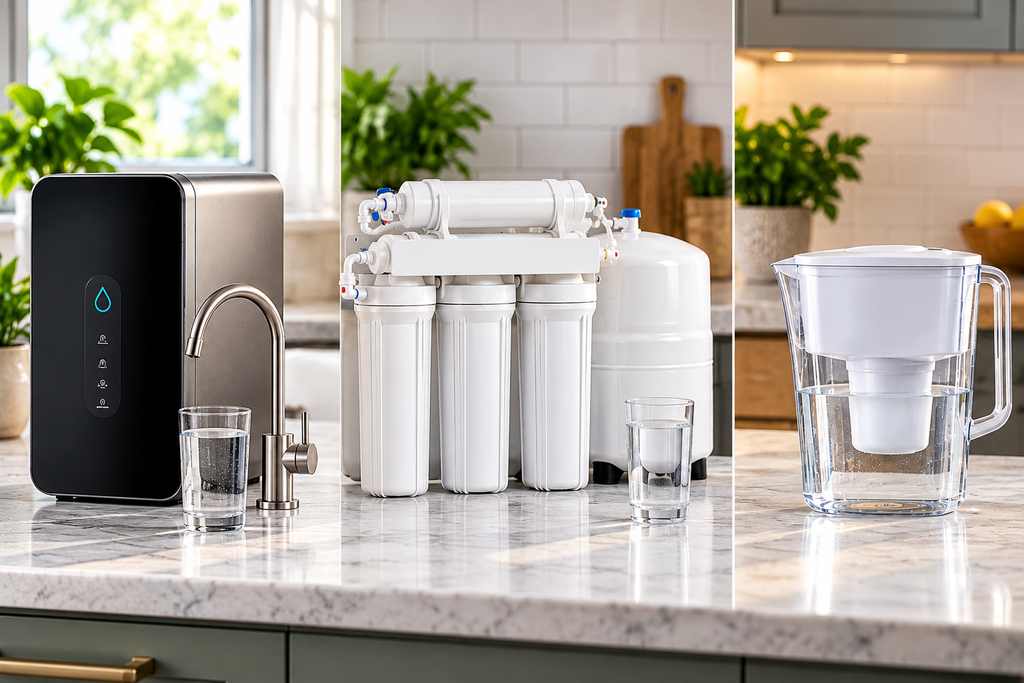
Before comparing individual systems, decide what kind of filtration setup fits your household.
Start with your water. Your municipal water-quality report or an appropriate water test can help identify what you actually want a filter to address. That is more useful than buying a system solely because it advertises a large number of filtration stages.
Decide whether you want reverse osmosis. RO systems use a membrane and typically require under-sink plumbing. They can provide more comprehensive treatment than a basic pitcher, but they also produce reject water and require more installation and maintenance.
Consider available space. Traditional RO systems usually include a storage tank. Tankless systems eliminate that tank but may require electricity.
Think about output. A pitcher may be perfectly adequate for one person filling drinking glasses. A household regularly filling bottles, cooking pots, coffee makers and multiple glasses can benefit from a higher-output system.
Look at certifications carefully. A certification only tells you what the product was certified for. Do not assume that seeing “NSF certified” means every performance claim made for a filter has been independently certified.
For other filtration formats, see our guides to whole-house filtration, countertop filtration systems, and affordable under-sink water filters.
1. Waterdrop G3P800 — Best Overall for High-Output Reverse Osmosis
The Waterdrop G3P800 makes the most sense for a household that wants the benefits of reverse osmosis without giving up a large section of the sink cabinet to a storage tank.
Waterdrop lists the G3P800 at 800 gallons per day with a 3:1 pure-to-drain ratio. It uses a tankless design, 10-stage filtration and a smart display faucet. Unlike the other RO systems in this comparison, it requires electricity.
The manufacturer currently lists certifications to NSF/ANSI Standards 42, 53, 58 and 372. Those standards address specific aspects of drinking-water treatment and materials; they should not be interpreted as blanket certification of every possible contaminant claim.
Who Should Choose It?
Choose the G3P800 if you want fast RO output, want to eliminate a bulky storage tank, and have both under-sink plumbing space and an electrical outlet available.
Tradeoffs
Its more complex powered design is unnecessary if your priority is simply dependable RO drinking water at a lower level of complexity. Buyers who want a non-powered traditional system should look closely at the APEC ROES-50 instead.
2. APEC ROES-50 — Best Traditional Tank-Style RO System
The APEC ROES-50 takes a more traditional approach. APEC specifies a five-stage reverse osmosis process, output of 50 gallons per day at 60 psi, and a four-gallon storage tank.
The system includes sediment filtration, two carbon-block stages, an RO membrane and a final coconut-shell carbon polishing filter. APEC identifies the ROES-50 as WQA Gold Seal certified.
The main advantage here is simplicity. There is no powered tankless architecture or smart faucet to consider. Water is treated and stored in the pressure tank so it is ready when you open the dedicated faucet.
Who Should Choose It?
The ROES-50 is a strong fit if you want traditional under-sink reverse osmosis, do not need extremely high output, and prefer a system that does not rely on electricity.
Tradeoffs
You need cabinet space for both the filtration assembly and storage tank. Its rated production is also far below the Waterdrop G3P800, although rated gallons-per-day figures should not be treated as a direct measure of how much water a typical household will actually consume.
3. iSpring RCC7AK — Best for Remineralization
Reverse osmosis removes dissolved material from water, which can leave the taste different from what some people prefer. The iSpring RCC7AK addresses that preference by adding an alkaline remineralization stage after RO treatment.
The RCC7AK uses six filtration stages. Water passes through sediment and carbon prefilters, the RO membrane and post-filtration before the final remineralization stage. The model appears in NSF’s official listing for NSF/ANSI Standard 58 reverse osmosis drinking-water treatment systems.
Who Should Choose It?
Consider the RCC7AK if you want a traditional under-sink RO system but specifically prefer a final remineralization stage rather than drinking RO water directly after post-carbon polishing.
Tradeoffs
Like the APEC system, it uses the traditional under-sink RO format rather than a high-output tankless design. The additional remineralization stage is a feature to choose because you want it—not because more stages automatically mean better filtration.
4. Clearly Filtered Water Pitcher — Best No-Installation Option
Not every household needs an under-sink RO system. If you rent, move frequently, have limited cabinet space, or simply do not want to modify plumbing, a pitcher can be a much easier solution.
The Clearly Filtered Water Pitcher holds 10 cups, or 80 ounces, of filtered water. NSF’s current listing shows the pitcher certified to NSF/ANSI 42 for chlorine taste and odor reduction and NSF/ANSI/CAN 372 for lead-free material requirements. Clearly Filtered rates the filter for 100 gallons.
The company also publishes broader independent laboratory testing for its filtration technology. Those broader performance claims should be evaluated separately from the specific claims covered by its NSF certification.
Who Should Choose It?
This is the easiest choice of the four for renters, apartments, dorm-style living, or households that primarily want filtered drinking water without installing equipment.
Tradeoffs
You have to refill the pitcher and wait for gravity filtration, and its capacity is fundamentally different from an under-sink RO system. For a family that uses filtered water heavily throughout the day, the convenience advantage may shift toward a plumbed-in system.
Reverse Osmosis vs. a Water Filter Pitcher
The decision between an RO system and a pitcher mostly comes down to how much installation and capacity you need.
Choose reverse osmosis when you want a dedicated filtered-water faucet, expect substantial daily use, and are comfortable installing and maintaining an under-sink system.
Choose a pitcher when convenience means avoiding installation altogether. A pitcher can also make sense for renters or as a lower-commitment starting point before investing in a permanent system.
There are other options between these two extremes. Faucet-mounted filters are another relatively simple approach; see our guide to faucet water filters for more.
What to Check Before You Buy

1. Your Actual Water Quality
Do not choose a filter based only on a long contaminant list. Identify the concerns relevant to your water supply first, then look for filtration performance and certifications that address those concerns.
2. Certification Scope
Look at the actual standard and certified reduction claims rather than stopping at an NSF, WQA or other certification logo.
3. Installation Requirements
Traditional RO systems need room for a tank. Tankless systems save that tank space but can require electricity. Pitchers require no plumbing at all.
4. Replacement Filters
Every filtration system has ongoing consumables. Before buying, check the current replacement-filter schedule and availability directly from the manufacturer.
5. Household Water Demand
Think in terms of how your household actually uses filtered water. A single person filling a few glasses has very different needs from a family filling bottles, kettles and cooking pots throughout the day.
Which Water Filter Should You Choose?
Among these four options, the Waterdrop G3P800 is the strongest choice for households prioritizing high-output tankless reverse osmosis. The APEC ROES-50 is the more straightforward choice for traditional RO without a powered tankless design, while the iSpring RCC7AK is the better fit when remineralization is a priority.
If installation itself is the deal-breaker, the Clearly Filtered Water Pitcher is the simplest path.
The important part is matching the system to your water, your available space and the amount of filtered water your household actually uses—not simply choosing the filter with the longest feature list.